






Least Restrictive Environment

The purpose of this page is to give educators and parents an overview of the different types of services that can be provided for a student with an Individualized Education Program (IEP). Least Restrictive Environment (LRE) is an important part of a child’s education and is a right under the Individuals with Disabilities Act (IDEA, 2004).
The Core of IDEA’s LRE Provisions

IDEA’s LRE provisions are found at §§300.114 through 300.117.
Each public agency must ensure that:
(i) To the maximum extent appropriate, children with disabilities, including children in public or private institutions or other care facilities, are educated with children who are nondisabled; and
(ii) Special classes, separate schooling, or other removal of children with disabilities from the regular educational environment occurs only if the nature or severity of the disability is such that education in regular classes with the use of supplementary aids and services cannot be achieved satisfactorily. [§300.114(a]
Continuum of Placement
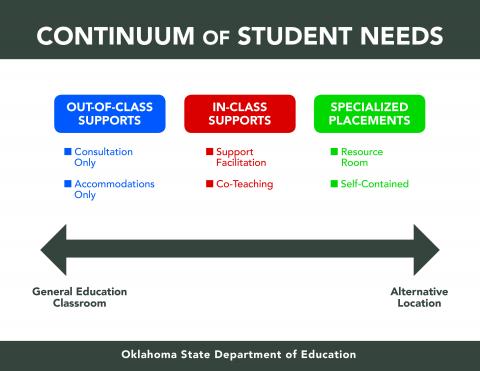
Having a continuum of placements available “is intended to ensure that a child with a disability is served in a setting where the child can be educated successfully in the LRE” (71 Fed. Reg. 46587). It also reinforces the importance of the individualized inquiry in determining what placement is the LRE for each child with a disability (Id.). As such, the requirement for a continuum of alternative placements supports the fact that determining LRE must be done on an individualized basis, considering “each child’s unique educational needs and circumstances, rather than by the child’s category of disability, and be based on the child’s IEP” (71 Fed. Reg. 46586).
This is why schools have been, and still are, required to ensure that “a continuum of alternative placements is available to meet the needs of children with disabilities for special education and related services” [§300.115(a)]. These placement options include:
• Regular classes
• Special classes
• Special schools
• Home instruction
• Hospitals and institutions
While it may be true that seeking the least restrictive environment is beneficial for children with disabilities, it's important to consider whether or not an option such as inclusion is right for every child. It may or may not be more appropriate for a child to be placed in a special education program, in a school for children with special needs, or in a home instruction program.
• Checklist: Least Restrictive Environment
► Special Education Instructional Methods

