






Special Ed Assessment

The Every Student Succeeds Act (ESSA) of 2015 prohibits schools from excluding students with disabilities from the educational accountability system. The Oklahoma State Department of Education, Special Education Services division is dedicated to ensuring students with disabilities and their unique needs are taken into account as they participate with their peers in the assessment process.
Oklahoma Alternate Assessment Program (OAAP)

Students with disabilities on an Individualized Education Program (IEP) must be included in all state and district-wide assessments. The IEP team determines annually how the student will participate in state and district-wide assessments - with or without accommodations, or through the alternate assessment.
The Oklahoma Alternate Assessment Program (OAAP) is a component of the Oklahoma School Testing Program (OSTP) and is designed for students with the most significant cognitive disabilities. The OAAP mirrors the general assessment system in regards to grade levels and subjects assessed and utilizes the Dynamic Learning Maps (DLM) Alternate Assessment System to measure academic content knowledge of students with significant cognitive disabilities. The academic achievement of students participating in the OAAP is measured against alternate achievement standards, which differ in complexity from the achievement standards of the general state assessments. In order to participate in the OAAP, students must require alternate achievement standards in all content areas and must have an IEP containing rigorous, measurable goals that include short-term benchmarks/objectives. In addition, students must meet the criteria identified in The Criteria Checklist for Assessing Students with Disabilities on Alternate Assessments and the IEP team must determine an alternate assessment is appropriate for the student. The Every Student Succeeds Act (ESSA) mandates that no more than 1% of all tested students may participate in an alternate assessment. IEP teams should discuss the accommodations needed for students to participate in the general assessment prior to considering eligibility in the alternate assessment.
Oklahoma's Definition of "students with the most significant cognitive disabilities"
In order for a student to participate in the OAAP:
1. The IEP team must determine annually that the alternate assessment is most appropriate for the student;
2. The student must meet the state-established criteria identified in The Criteria Checklist for Assessing Students with Disabilities on Alternate Assessments; and
3. ESSA requires districts to inform parents when their child will participate in the OAAP. In response to this need, OSDE-SES has created the OAAP Parent Brochure (English | Spanish). DLM has created its own DLM Parent Brochure that can also be provided to parents.
OAAP Cap on Participation Waiver: 2023-2024
The Every Student Succeeds Act (ESSA) requires States to ensure the total number of students assessed in a subject using an alternate assessment does not exceed 1.0 percent of the total number of students in the State who are assessed in that subject. School districts that assess more than 1.0 percent of its assessed students in any subject with the OAAP are required to submit a statement justifying this need annually (34 CFR § 200.6(c)(3)(iv)).
- OAAP LEA Justification Statements 2023-2024
- 2023 OSDE Request for a waiver extension
- 2023-2024 1% waiver extension approval
2023 OAAP Tiered Monitoring Information
OAAP 1% Toolkit- Fillable Form
2023-2024 OAAP
Operational Testing Schedule
OAAP Spring Window: March 25 - May 15, 2024 (DLM Year-End)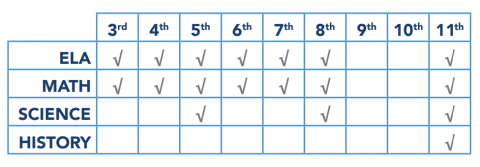
Requirements for Test Administrators 2023-2024
Required test administrator training for teachers administering 2023-2024 DLM assessments is completed in Kite Educator Portal. The Guide to DLM Required Test Administrator Training includes more information about the training.
• 2023-2024 List of Required Training for Returning DLM Test Administrators
• 2023-2024 List of Required Training for New DLM Test Administrators
2023-2024 Updates & Memos
OAAP Updates and memos contain timely information regarding the State's alternate assessment system and are disseminated through electronic mailing lists. Please fill out this form if you wish to receive OAAP Updates and memos via the mailing list.
• 2023-2024 OAAP Updates and Memos
• 2023-2024 OAAP Handbook
Curriculum Maps Aligned to the Essential Elements
OAAP Elementary Curriculum Maps
OAAP Middle School Curriculum Maps
Curriculum Map Feedback Google Form
Dynamic Learning Maps (DLM)
Alternate assessments are delivered through Dynamic Learning Maps (DLM), which is an online platform. For some students, teachers present the items and enter the student's response to the online platform.
DLM Offers Two Types of Assessments
The DLM Alternate Assessment system contains both an Instructionally Embedded (IE) assessment and a Year-End (YE) assessment. Instructionally Embedded assessments are optional but are highly recommended. The optional IE assessments do not affect student performance level results but are designed to integrate classroom instruction and assessment in a cycle throughout the year. The Year-End assessment is required and is used for the purpose of State and federal accountability.
DLM Instructionally Embedded Assessment Window (Optional): September 11, 2023 - February 23, 2024
• Instructionally Embedded Assessments 2023-2024
| Assessment System | Blueprints | Manuals (2023-24) | Guides & Training (2023-24) |
|---|---|---|---|
|
(844) 261-6481 |
|
• Assessment Coordinator Manual
• Technology Specifications Manual
|
• Guide to Practice Activities and Released Testlests
• DLM Mathematics Materials Collections
|


-
District-Level Resources for District Test Coordinators and Special Education Director
• Oklahoma Dynamic Learning Maps - Manuals, guides, blueprints, and other Dynamic Learning Maps resources designed for District Test Coordinators, Special Education Directors, and teachers.
• Educator Resource Page for English Language Arts Mini Maps - Mini Maps will help guide your instruction for Essential Elements that are assessed on the OAAP.
• Educator Resource Page for Mathematics Mini Maps - Mini Maps will help guide your instruction for Essential Elements that are assessed on the OAAP.
• Educator Resource Page for Science Mini Maps - Mini Maps will help guide your instruction for Essential Elements that are assessed on the OAAP.
• Educator Resource Videos - Videos providing information about assessment format, accessibility, and Educator Portal procedures.
• DLM Professional Development page - This site was developed to provide professional development for educators working with students with significant cognitive disabilities. It focuses on teaching and learning in the areas of English language arts and mathematics, while also providing important information regarding components of the Dynamic Learning Maps™ system.
• ELA Exemplar Texts - Find texts appropriate for your grade band. These texts may be downloaded and used in instruction.
• 2023-2024 OAAP Timeline for District Test Coordinators - Lists monthly tasks/reminders on a one page document for District Test Coordinators to utilize as a resource.
• District Test Coordinator Steps for OAAP - Dynamic Learning Maps (DLM) quick reference guide for District Test Coordinators.
• DLM- Add a Student Record Manually - Quick reference guide for District Test Coordinators to add a student in Kite Educator Portal.
• DLM- Creating a Roster Manually - Quick reference guide for District Test Coordinators to create a roster in Kite Educator Portal.
• OAAP Accessibility Tracker - Quick reference guide for educators on the accessibility features available for OAAP testing.
2022 Professional Development Trainings

